Tuesday, July 31, 2018

Banking in Developing Countries Saturday, April 01, 1995

Banking in Developing Countries

Central Banks Have Caused Poor Monetary and Economic Performance
Mr. Schuler is an economist in Arlington, Virginia.
Twenty-five years ago, most of the world’s currencies were linked to the dollar by fixed or pegged exchange rates. (I will explain those terms later.) The system was known as the Bretton Woods system, named after the New Hampshire town where an international monetary conference establishing the system had been held in 1944. Although the dollar was far from perfect, it provided some discipline against inflation and thereby aided economic growth, especially for developing countries. From 1960 to 1970, average annual inflation in developing countries was 3-4 percent, about the same as in developed countries.[1] The rather spotty statistics of economic growth for developing countries indicate that growth per person was increasing roughly as fast as in developed countries.
The Bretton Woods system began to unravel in 1971 and collapsed completely by 1973. It unraveled because the U.S. government abandoned the policy of keeping the dollar convertible into gold at $35.00 per troy ounce. Over the years the Federal Reserve System, the U.S. central bank, created money too fast to be compatible with the government’s stock of gold at the existing exchange rate. Foreigners therefore converted dollars into gold at a rapid rate, which reduced the U.S. government’s stock of gold. Rather than replenish the stock of gold by having the Federal Reserve raise interest rates, the U.S. government decided to make the dollar a floating currency in terms of gold.
Other countries thought that they could do better by floating their currencies also, rather than maintaining pegged exchange rates with either the dollar or gold. At first it was mainly developed Western countries that floated their currencies. Over time, though, more and more developing countries also floated their currencies against the dollar.
After the collapse of the Bretton Woods system in the early 1970s, developing and developed countries alike experienced lower growth and higher inflation. From 1970 to 1980, average annual inflation was 9.1 percent in developed countries and 26.2 percent in developing countries. But since about 1980, developed countries have reduced inflation, while developing countries have not.
From 1980 to 1992 average inflation for developed countries fell to 4.3 percent a year, while for developing countries it accelerated to an astounding 75.7 percent. The result has been a slowdown in economic growth for developing countries. From 1980 to 1992, economic growth was 2.3 percent per person a year in developed countries, but only 0.9 percent in developing countries. The trend has continued since 1992. Only a few East and South Asian developing countries grew rapidly; many other developing countries actually had declining income per person.
Central Banks Responsible
The dramatic rise in inflation and fall in economic growth in many developing countries since 1971 has been caused by their central banks. Except in Latin America, few developing countries had central banks before the 1950s. Until then most developing countries were colonies of European countries, particularly Britain and France. The currencies of almost all developing countries were linked in one way or another to the dollar, pound sterling, or franc. The dollar, sterling, and franc all experienced difficulties before 1971, but even so they imposed a sort of quality control on the currencies of developing countries by means of exchange-rate links.
Before developing countries established central banks they had a variety of arrangements for maintaining exchange-rate links with the dollar, sterling, or franc. A few countries had free banking–competitive issue of banknotes by commercial banks–although government intervention ended that system before World War II in most places where it had existed. Other countries, including some French and Portuguese colonies, had monopoly issue of notes by a commercial bank that was granted the monopoly privilege by the government. Still other countries, mainly French colonies, had monetary institutes. A monetary institute is a government body that issues banknotes under fairly strict rules, such as a requirement that it have foreign reserves (bank deposits or high-quality bonds in a foreign currency) of 50 percent or more against its banknotes in circulation and other liabilities. Monetary institutes in French colonies were supervised by the French government, which kept a watchful eye on them because it did not want to pay for their mistakes.
Still other developing countries, mainly British colonies, had currency boards. A currency board is a monetary authority that issues banknotes and coins (and, in some cases, deposits) backed 100 percent by assets in a foreign “anchor” currency and fully convertible into the anchor currency at a fixed exchange rate and on demand. As reserves, a currency board holds low-risk, interest-earning bonds and other assets payable in the anchor currency, equal to 100 percent or slightly more of its bank notes and coins in circulation (and deposits, if any), as set by law.,
Although there. were differences in the ways that these monetary systems worked, they shared two important features. The first was that all provided relatively low inflation by means of stable exchange rates to their anchor currencies or to gold or silver. The second feature’ which was related to the first, was that all kept government away from the monetary printing press, through private ownership (in the case of free banking and monopoly issue of notes by a commercial bank) or strict rules governing monetary policy (in the case of the currency board and monetary institute systems).
The record of these pre-central banking monetary systems was very good. Devaluations happened occasionally except in currency board systems, but they were imposed by governments and were not the fault of commercial banks or monetary institutes. Most of the pre-central banking systems maintained full convertibility of their own currencies into their anchor currencies; that is, there were no restrictions on exchanging their currencies into the anchor currencies.
The record of central banks in developing countries was much worse even before the 1970s. During the Bretton Woods period (1946-1971), central banks in developing countries that had signed the Bretton Woods agreement carried out more than 150 devaluations. All but a few developing countries with central banks devalued against their anchor currency-typically the dollar-at least once during the period. And few had currencies that were fully convertible into their anchor currency; instead, they had extensive restrictions or outright prohibitions on exchanging their currency into any foreign currency.
Exchange-Rate Systems and Inflation
Developing countries have done much worse by having central banks than they would have done by continuing their previous monetary systems or by ceasing to issue their own currencies and using the dollar, sterling, or franc instead. The reasons have to do with the relation between exchange-rate systems and inflation.
There are three types of exchange-rate systems: fixed, pegged, and floating. In theory a developing country could have a high-quality currency under any of these systems, but in practice a fixed exchange rate is the only system with a consistent record of doing the job. Free banking, monopoly issue of notes by a commercial bank, the monetary institute system, and the currency board system were all systems of fixed exchange rates.
People often confuse fixed and pegged exchange rates. They are quite different, however, and have quite different effects. Both are maintained constant in terms Of an anchor currency (which can be gold), but the similarity ends there. A pegged exchange rate is maintained constant for the time being in terms of the anchor currency, but carries no credible long-term guarantee of remaining at its current rate. A fixed exchange rate is preferably established by law as permanent, or at most is alterable only in emergencies. A rough-and-ready classification is that a truly fixed exchange rate is altered no more than once every thirty years. (Thirty years is the longest period for which there are active bond and mortgage markets in many countries.) If the exchange rate is altered more than every thirty years it should be considered pegged.
Many people think the Bretton Woods system was one of fixed exchange rates. It was not; rather, it was a mixture of fixed and pegged rates. Few currencies in the Bretton Woods system floated: in 1970 the only ones were the Canadian dollar, South Korean won, and Lebanese pound. As I mentioned, most central banks in developing countries that had signed the Bretton Woods agreement devalued at least once during the Bretton Woods period. The record of central banks in developing countries was no better: most of them devalued at least twice during the period. In contrast, few of the pre-central banking systems (and no currency board systems) devalued during the Bretton Woods period.
Since the Bretton Woods system ended the pattern has continued. The collapse of the Bretton Woods system continued the weakening of barriers to inflation that began when developing countries established central banks. Of the more than 150 developing countries with central banks, the currencies of all but a dozen have depreciated against the dollar since 1970. Some of the depreciations have been huge: a Russian ruble is today worth about 1/4,000 its 1970 value in dollars, and the Brazilian currency, adjusted for all the zeros that have been chopped off it over the years, is worth less than one-billionth its 1970 value.
Central banks have performed so poorly in developing countries because pegged and floating exchange rates alike do not furnish enough of a barrier against political pressures for inflation. Pegged exchange rates have not worked well in developed countries or developing countries. They invite currency speculators to profit from a devaluation that is almost certain to occur eventually. The Bretton Woods system collapsed because the U.S. dollar was pegged rather than fixed to gold. The largest attempt to peg exchange rates since the Bretton Woods system is the Exchange Rate Mechanism of the European Monetary System, which links several West European currencies to the German mark, It has experienced great difficulties leading to successful speculative attacks on most of its currencies on several occasions, most recently in 1992 and 1993. Among developing countries, the devaluations of the CFA franc (the currency of 13 former French African colonies) and the Mexican peso in 1994 are recent examples of the difficulty of maintaining pegged exchange rates.
Floating exchange rates have a better record in developed countries. After the painful inflationary experience of the 1970s, developed countries found ways to keep inflation to levels not much higher than during the Bretton Woods period. Control of inflation in developed countries has been erratic, but it has been superb compared to developing countries. However, few developing countries have succeeded for long periods in combining low inflation and floating exchange rates. For example, the severe inflations that have occurred in many former Communist countries since 1989 have occurred mainly in floating exchange-rate systems.
All this experience suggests that the only way for most developing countries to have low inflation is to forget about pegged or floating exchange rates and to have a truly fixed exchange rate with a relatively stable anchor currency issued by a developed country, such as the dollar. And the only way to have a truly fixed exchange rate is to abolish central banks in developing countries and return to one or another of the pre-central banking systems.
The Ebb of Central Banking?
In the 1950s and 1960s a powerful combination of misplaced nationalism and interventionist economics convinced most developing countries that to assert their sovereignty and to fine-tune the economy they needed to replace their monetary institutes or currency boards with central banks. All but a handful of developing countries established central banks.
Recently the tide has began to turn. On the heels of an inflation exceeding 2,000 percent a year, Argentina stabilized its currency by means of a currency board-like system in April 1991. Estonia, which had suffered inflation exceeding 1,000 percent a year under the Soviet ruble, issued a new currency by means of a currency board-like system in June 1992. And after breaking free of the Soviet Union, experimenting with central banking, and suffering inflation exceeding 1,000 percent a year in 1992, Lithuania established a currency board-like system in April 1994. Argentina and Lithuania use the dollar as their anchor currency, while Estonia uses the German mark.
Like orthodox currency board systems, the Argentine, Estonian, and Lithuanian systems have 100 percent foreign reserves. Unlike orthodox currency board systems, though, they have had some restrictions on convertibility (now weak or removed) and the fixity of the exchange rate is not entirely secure because the monetary authorities are not well insulated from political pressure. Even so, since establishing currency board-like systems all three have had much lower inflation and have reversed the economic decline they were previously suffering. Their experience contrasts with the experience of other countries in their regions that have retained central banking. Estonia and Lithuania are enjoying economic growth while Russia, Ukraine, and most other former Soviet republics continue to have economic decline and inflation of hundreds of percent a year. Argentina has had four consecutive years of economic growth and has reduced inflation to mid-single digits, which is highly unusual for Latin America.
Other countries in Latin America and the former Soviet Union are now considering establishing currency boards or currency board-like systems. Monetary institutes are not experiencing a similar revival because their principles are not as simple and understandable as those of currency boards. Free banking has received attention from a growing number of economists, but has not yet convinced a broader political constituency.
Developing countries established central, banks with high hopes that have been unfulfilled. The best thing they can do to reverse their poor monetary and economic performance of recent years is to abolish their discretionary central banks and fix their currencies to foreign currencies with relatively good records of low inflation. The currency board system is a well understood and eminently practical way of doing so. Other alternatives to central banking are also worth considering. The important thing is to minimize, and preferably eliminate, discretionary government control in monetary policy.

1.   Statistics of inflation and economic growth cited in the next few paragraphs are from World Bank, World Development Report, 1982, pp. 110-11, and 1994, pp, 162-63. Within groups, statistics are weighted by gross national product (GNP), so countries with large GNPs affect the group statistics more than countries with small GNPs

Timely stories and timeless principles, delivered daily to your inbox.

Sign up for the FEE Daily!

Friday, July 27, 2018

Against competitive spectator sports

rg-07/27/18

Against competitive spectator sports :

“Because the average man was to become more disengaged from his own destiny as the expert class arose, it was decided that the males would get their outlet, basically, gradually becoming helpless, as males, through sports. Therefore they’d have a tribal team they identified with, they could achieve the model as if they’re winning, and in their own personal lives they’re getting no further, they’re getting disenfranchised, in a sense, as experts took over decision-making for them in all kids of fields.” ~Alan Watt


William Cooper was one of the original American conspiracy theorists, having written Behold a Pale Horse in 1991, shining light onto many of the elite plans for national and global domination. He too spoke of how sports is used to pacify the masses, and how it creates extraordinary distortions in the value of male energy.

“It’s the Roman Circus. What does the Emperor do when the people become restive, and when the people are asking questions. When the people don’t like the policies of the Emperor, he sends them to circus! He creates a circus, fills a giant coliseum, and he begins to throw the Christians to the lions. And he has great chariot races. And football games. And basketball games. All to keep the idiots preoccupied with things that don’t mean anything in the scheme of the entire world.” ~Bill Cooper

This year will be no different, and as the world watches a major display of fictitious tribalism, police state surveillance and military worship, a look into history reminds us of just how far we’ve come down the road of mental slavery and mass distraction.

The following video features clips of Watt and Cooper talking about the role of football and male sports culture plays in controlling the masses and capturing our natural drive for conquest and competition so that we have no energy available to revolt against the tyranny of authoritarianism.


https://www.youtube.com/watch?time_continue=24&v=ZEiZ0j1Jx2M

Saturday, July 21, 2018

fallacy to believe the US has a free market economy. Ron Paul

The Dollar Dilemma: Where to From Here?

Posted on June 26th, 2018 - 0 Comments

This article was written by Dr. Ron Paul and originally appeared at the Mises Institute.

Introduction: Where We Are 

It’s a fallacy to believe the US has a free market economy. The economy is run by a conglomerate of individuals and special interests, in and out of government, including the Deep State, which controls central economic planning.
Rigging the economy is required to prevent market forces from demanding a halt to the mistakes that planners continuously make. This deceptive policy can last only for a limited time. Ultimately, the market proves more powerful than government manipulation of economic events. The longer the process lasts, the greater the bubble that always bursts. The planners in charge have many tools to perpetuate confidence in an unstable system, but common sense should tell us that grave dangers lie ahead.
Their policies strive to convince the unknowing that the dollar is strong and its status as the world’s reserve currency is secure, no matter how many new dollars they create of out of thin air. It is claimed that our foreign debt is always someone else’s fault and never related to our own monetary and economic mismanagement.
Official government reports inevitably claim inflation is low and we must work harder to increase it, claiming price increases somehow mystically indicate economic growth.
The Consumer Price Index is the statistic manipulated to try to prove this point just as they use misleading GDP numbers to do the same. Many people now recognizing these reports are nothing more than propaganda. Anybody who pays the bills to maintain a household knows the truth about inflation.
Ever since the Great 

Wednesday, July 11, 2018

Real number of unemployed in the US is hidden -- Society's Child -- Sott.net

Real number of unemployed in the US is hidden -- Society's Child -- Sott.net: https://www.sott.net/article/390696-Real-number-of-unemployed-in-the-US-is-hidden

-How-The-West-Misjudged-Asia

https://www.sott.net/article/390575-How-The-West-Misjudged-Asia


India

India worked out splendidly, just as we planned. Although India was hesitant about opening up its economy - understandable given their experiences with British colonialism - we gained their trust by helping millions of Indians emigrate to the West. In return, India privatized most of their major industries, including their media, and allowed us to become major shareholders. Now, India is tightly integrated into our system.

China

Chiiiiina! The biggest prize slipped away from our fingers. Most people don't realize that the Tiananmen Square uprising in 1989 was actually a "color revolution" manufactured by the CIA, MI6 and social engineering experts, Gene Sharp and George Soros. We even recruited China's 'Gorbachev' - Zhao Ziyang, the top leader of the Chinese Communist Party. Alas, the plan failed and Zhao Ziyang ended up spending the rest of his life under house arrest.

After that, we decided to pursue a patient approach, since we didn't want to lose China's efficient and cheap factories. Furthermore, we assumed that:
As China got richer, its people would rise up and get rid of the communist party
Western products would always dominate the Chinese consumer market
Chinese manufacturing would remain stuck in the low/medium-end of the value chain, since innovation is impossible in an authoritarian society.
China would only become a regional power. Throughout its history, China never showed any skill or interest in foreign relations.
Well, guess what, every one of our assumptions turned out to be wrong. China's GDP grew 27-fold from 1989 to 2017, and yet 84% of Chinese are happy with their socialist government. Also, what was supposed to be just a factory for the West, became the largest trading partner for more than 130 countries.

Confounding our expectations, China has become #1 or #2 in many areas of hi-tech industries including solar energy, electric vehicles, smartphones, supercomputers, Artificial Intelligence and mobile payments. 9 out of the top 20 most valuable internet companies are now Chinese. The fact that a Chinese company, ZTE, made the world's first 5G phone call earlier this year should be a "Sputnik Moment" for us.

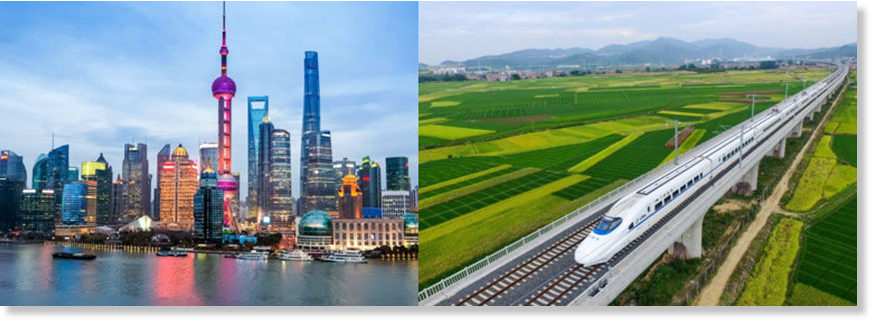
Worst of all, China has proved the benefits of public banking. Without the government getting into debt, Chinese public banks give massive long-term loans for infrastructure at extremely low interest rates. This has enabled China to build 25,000 Km of high-speed railway systems and modern cities and other infrastructure projects that benefit the Chinese people. Such a socialistic model makes our private banking system look bad!
China economyFinally, we never thought that China would develop a grand vision such as the Belt and Road Initiative. While we build military bases around the world, China is building high-speed railways, highways, seaports, airports, power plants and pipelines in 65 different countries. If this continues, there's no doubt who's going to have more global influence in the near future.

The biggest threat to western dominance is the Made in China 2025 plan. If they achieve expertise in semiconductor chips and a few other industries, we will lose our global hegemony.


Stock Up

How The West Misjudged Asia

Dear diary, I am writing about an ingenious plan that went awry and altered the trajectory of history. The plan was conceived and implemented over a century by my colleagues and their predecessors, the smartest and the most visionary people in the world. Merely 25 years ago, the plan seemed to have come to fruition, and western intellectuals talked not only about the end of the Cold War, but the "end of history." We were excited about the imminent New World Order (which is now referred to as the "international rules-based order"). Then Asia happened.

After WWII, we established an unprecedented system to control half the world. Thus, in 1992, we were confident about bringing in the other half.

In the early 1990s, China and India represented not only 40% of world's population, but also a vast pool of consumers and diligent workers. After decades of poverty, Chinese and Indians were eager and grateful to embrace capitalism. On the other hand, my colleagues also appreciated the opportunity to make trillions of dollars every year. It was win-win.

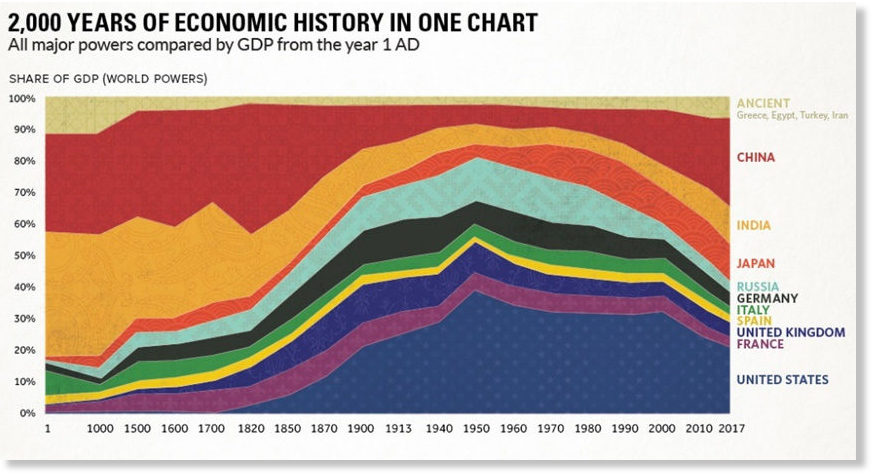
The only ones who doubted this plan were those who didn't know that for the first 1800 years of this millennium, the two largest economies in the world were ... China and India.
2000 years economic history
Of course, bringing more than 2 billion people into our system would also mean a sudden loss of jobs, drastic reduction in wages, and a painful drop in the standard of living for many Americans and Europeans. However, that was a small price to pay for our bigger ambition.

India

India worked out splendidly, just as we planned. Although India was hesitant about opening up its economy - understandable given their experiences with British colonialism - we gained their trust by helping millions of Indians emigrate to the West. In return, India privatized most of their major industries, including their media, and allowed us to become major shareholders. Now, India is tightly integrated into our system.

China

Chiiiiina! The biggest prize slipped away from our fingers. Most people don't realize that the Tiananmen Square uprising in 1989 was actually a "color revolution" manufactured by the CIA, MI6 and social engineering experts, Gene Sharp and George Soros. We even recruited China's 'Gorbachev' - Zhao Ziyang, the top leader of the Chinese Communist Party. Alas, the plan failed and Zhao Ziyang ended up spending the rest of his life under house arrest.

After that, we decided to pursue a patient approach, since we didn't want to lose China's efficient and cheap factories. Furthermore, we assumed that:
  • As China got richer, its people would rise up and get rid of the communist party
  • Western products would always dominate the Chinese consumer market
  • Chinese manufacturing would remain stuck in the low/medium-end of the value chain, since innovation is impossible in an authoritarian society.
  • China would only become a regional power. Throughout its history, China never showed any skill or interest in foreign relations.
Well, guess what, every one of our assumptions turned out to be wrong. China's GDP grew 27-fold from 1989 to 2017, and yet 84% of Chinese are happy with their socialist government. Also, what was supposed to be just a factory for the West, became the largest trading partner for more than 130 countries.

Confounding our expectations, China has become #1 or #2 in many areas of hi-tech industries including solar energy, electric vehicles, smartphones, supercomputers, Artificial Intelligence and mobile payments. 9 out of the top 20 most valuable internet companies are now Chinese. The fact that a Chinese company, ZTE, made the world's first 5G phone call earlier this year should be a "Sputnik Moment" for us.

Worst of all, China has proved the benefits of public banking. Without the government getting into debt, Chinese public banks give massive long-term loans for infrastructure at extremely low interest rates. This has enabled China to build 25,000 Km of high-speed railway systems and modern cities and other infrastructure projects that benefit the Chinese people. Such a socialistic model makes our private banking system look bad!
China economy
Finally, we never thought that China would develop a grand vision such as the Belt and Road Initiative. While we build military bases around the world, China is building high-speed railways, highways, seaports, airports, power plants and pipelines in 65 different countries. If this continues, there's no doubt who's going to have more global influence in the near future.

The biggest threat to western dominance is the Made in China 2025 plan. If they achieve expertise in semiconductor chips and a few other industries, we will lose our global hegemony.

Rest of Asia

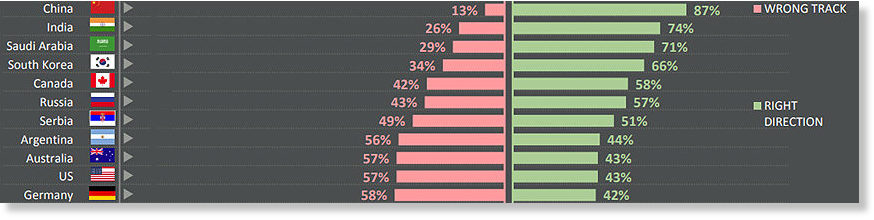
Something remarkable is happening all over Asia. After WWII, Japan succeeded in a brilliant way, which in turn inspired the so-called Asian Tigers - South Korea, Hong Kong, Taiwan and Singapore. However, the wild fire of enthusiasm really caught on when China lifted 700 million people out of extreme poverty and created the world's largest middle class. Now every country from India to Indonesia to Vietnam feels optimistic and confident that they can succeed as well, and many of them are consistently growing at 6-7% per year. Asians are now far more optimistic than westerners about the direction of their countries.
Chinese people approval economy
Asian countries - including even North Korea - have realized that wars and conflicts only get in the way of prosperity. All this is very bad for our divide-and-rule strategy - we were hoping to use Taiwan, Philippines, Japan, South Korea, Vietnam and India to contain China.

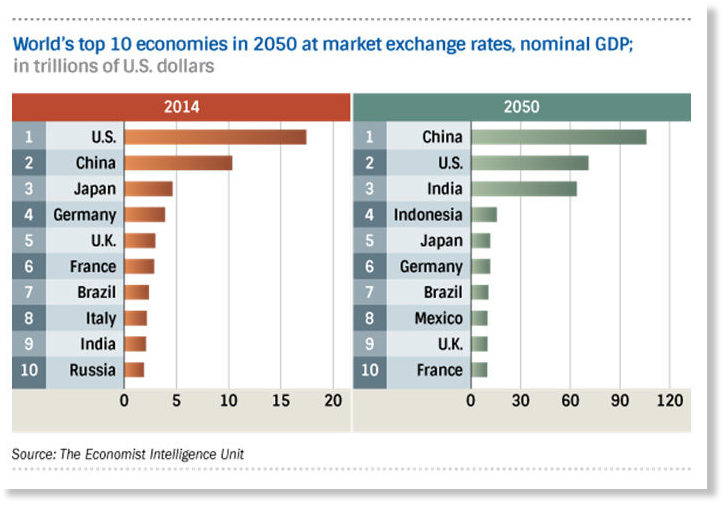
If Asia continues to enjoy peace and cooperation, the geopolitical center of gravity will shift dramatically. Many people don't realize that, in terms of purchasing power, China is already larger than the US. In terms of nominal GDP, by 2030, China will be bigger than the US, India will be bigger than Germany, and Asia's GDP will account for 40% of global GDP.

By 2050, the top five world economies could consist of four Asian countries.
top ten economies 2050
While the rising Asian middle class is a lucrative consumer market for our corporations, we dread the rise of multi-national Asian corporations in a decade or two. In other words, we want Asians to be rich enough to buy Colgate and Pampers, but not so rich they can mass produce toothpaste and diapers.

Conclusion

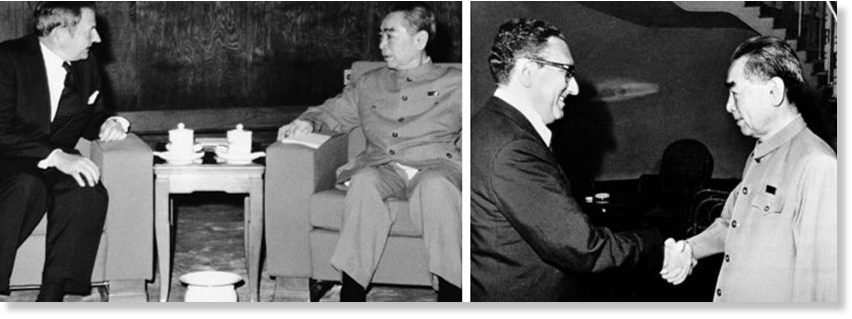
In the early 1970s, David Rockefeller and Henry Kissinger convinced the Chinese elites to open up their economy.
Rockefeller and Kissinger China
Then we created the WTO in 1995 and enlisted 128 countries, knowing very well what it would do to American/European manufacturing. Letting China into the WTO in 2001 accelerated the demise of the working class in Europe and the US. To hide the devastation, we created the housing bubble on both sides of the Atlantic Ocean. Now, we're also effectively using mass immigration and other social engineering tools to keep people distracted.

I will admit that, blinded by hubris and greed, we misjudged the rise of Asia, especially China. However, let me remind you that we have brought down many would-be empires over the last 250 years. We're not going to simply sit back and let revisionist powers rewrite the world order. The next decade will be both fascinating and dangerous.
Avatar
Chris Kanthan (Profile)
Chris Kanthan is the author of a new book, Deconstructing the Syrian war.. Chris lives in the San Francisco Bay Area, has traveled to 35 countries, and writes about world affairs, politics, economy and health. His other book is Deconstructing Monsanto.. Follow him on Twitter: @GMOChannel
See Also:

Reader Comments

gdpetti
gdpetti · 2 days ago
Or, as others have stated, this is an engineered 'rise and fall of civilizations'. James Corbett of corbettreport has mentioned this before... Prof Sutton mentioned it a few decades back in relation to the rise and fall of our Bolshevik regime change op in Russia.... the telltale sign of SG involvement... working both ends of the candle simultaneously.

Corbett mentioned this again today on his site... in the video after the flooding in Japan stuff: [Link]
TrhthHunter
TrhthHunter · 2 days ago
I see a lot of products on Aliexpress and alibaba for less than the cost of production even in China. overproduction is rampant. they are borrowed to the hilt and will probably have a panic. I would be surprised if we don't see a major down turn in China very soon. At best, they are likely to be flat for the next 30 years like Japan has been since the 90's
lk2000
lk2000 · 2 days ago
TrhthHunter -- If China is borrowing too much to produce ... we're borrowing too much to consume. Guess who's more likely to go bankrupt first?
Plane Will
Plane Will · about 19 hours ago
Sorry to correct a mostly factual piece. But there are only 1000 years in a millennium.

How can 2 nations have the greatest economies for the "first 1800 years of this millennium"
graeme15b
graeme15b · about 16 hours ago
They also misjudged the rise of Russia, as they thought Russia would never recover from the collapse of the Soviet Union. Now they hate everything Russia, and Putin, as Russia has spectacularly risen rapidly under Mr Putin.
katesisco
katesisco · about 15 hours ago
While they have indeed had production and financial 'turndowns', they will manage to recover just like we have. After all, China was there first, and has managed to be a consolidated country long before us. Haven't we copy catted from Chna many times?

The disposal of an entire generation of Red Guard was so spectacularly successful, the US used the same distractions to dispose of TWO GENERATIONS instead of one. The expected retirements allowing paid off homes has been deep sixed, and the children of same have lost their earning power and are living with their parents and riding the bus. The grandchildren are in a holding pattern......India's caste has been a shining star for all democratic countries to follow. Only it appears we here in the US have to rely on fluoride and chlorine and multiple mercury exposures to create a class that can be convinced only body work in an abandoned block building is their future. But thankfully, we have a manipulated media to interpret events for us so no matter how many American tanks we see on the strasse outside the window, we can be sure we're winning the war.
whalemind
whalemind · about 11 hours ago
Illuminating. Thank you.
RBHoughton
RBHoughton · about 7 hours ago
What has become apparent with the differing economic policies of USA and China is the former is involved in sanctions and forced trade whilst the latter desperately needs more open trade.

The US economy is often represented by Wall Street but those bankers have been using interest free money to buy back shares in the public companies they trade on the NYSE to the point that those companies have few shareholders from amongst the general public. The connection between normal Americans and the financial gang has disappeared.

China is obliged to increase trade to maintain the great advance that Chinese people have enjoyed this last 40 years. They are at the stage where the whole world must be involved in growing the economy. The land connections to the rest of Asia, Europe and Africa are safe but the maritime silk road is exposed to disruption and will be delayed. Nevertheless, our prospects are very hopeful.

It is our fortune or misfortune to be alive when a change in the basis to everyday life is occurring. We will need patience and courage but the light at the end of the tunnel is already apparent. We will soldier on.

Wednesday, July 4, 2018

saker

Each “click” brings us one step closer to the “bang!”

[This column was written for the Unz Review]
Trump pulled the trigger, but instead of a “bang!” what the world heard was a demure “click”. Considering that we are talking about playing a most dangerous game of potentially nuclear Russian AngloZionist roulette, the “click” is very good news indeed. But, to use the words of Nikki Haley, the US “gun” is still “locked and loaded”.
There are a number of versions out there about what really happened, but I think that the most likely explanation for that “click” is a combination of two events:
  1. The US did go out of its way to avoid even giving the appearance of attacking the Russian or Iranian forces in Syria. With these kinds of rules of engagement, the target list and flight trajectory of the US missiles was easy to predict for the Syrian air defenses.
  2. The Syrian air defenses, now integrated with the Russian C4ISR networks and probably upgraded, performed way better than most people had expected.
I honestly don’t know who in the US should get the credit for doing the right thing, but that person(s) deserves our collective gratitude. Rumors say that Mattis was the man, others point to Dunford and some even to Trump himself (I doubt that). Again, I don’t know who did it, but this action deserves a standing ovation. The fact that this (predictably) dismal performance was then covered up with silly statements about a “perfect strike” and “all missiles hit their target” is standard operating procedure, a basic exercise in face-saving and an attempt to appease the always bloodthirsty Neocons. The most important lesson from this latest development is that there are still some people in key positions in the US who did what had to be done to avoid a catastrophic escalation in Syria. The question now is how long can these “sane forces” (for lack of a better identifier) continue to resist the “crazies”?
Needless to say, the Israel Lobby and the Neocons are absolutely furious. And just to add insult to injury, the Russians are now saying that they will provide the Syrians with S-300 batteries (which would be able to track and engage Israeli aircraft practically from their take-off). I would argue that the Israelis did that one to themselves with their own missile strikes at the worst possible time, but the fact this is self-inflicted does not make it less painful for the Israelis.
But the biggest problem is that this outcome, while very positive by itself, really solves nothing. The key unresolved issues are
  1. Does anybody, especially the UNSC or/and Russia get to “veto” the AngloZionist Hegemony’s actions anywhere on the planet? The official US position is a categorical “no!”. The outcome in Syria, however, does strongly suggest a “yes”.
  2. Is the US willing to come to terms with the fact that the Hegemony has failed to overthrow the Syrian government and that the Syrians have won the war? The official US position on this has flip-flopped a number of times, but I would argue that the “no” camp is much stronger than the “yes” camp. The current US posture in Syria strongly suggests that the USA is not quite ready yet to “declare victory and leave”.
  3. Have the Skripal and Douma false flag chemical (pseudo-) attacks been sufficient to re-subordinate the post-Brexit EU to the Anglosphere and have the AngloZionists been successful in forging a united front for a “Crusade against Russia”? The majority of EU governments have been willing to endorse any nonsense or violation of international law under the pretext of “solidarity”, but there are still quite a few cracks in this apparent unity.
At this moment the situation is extremely fluid and there are too many potential variables which can determine the next developments in order to make a prediction better than a wild guess. The only thing which is certain that this confrontation between the AngloZionist Hegemony and Russia is far from over, both in Syria and elsewhere (the Ukraine).
Fundamentally, our entire planet has to make a choice between two mutually exclusive world orders.
AngloZionist HegemonyMultipolar world
Civilizational modelSingle “western”Diverse
Economic modelCapitalismDiverse
Political modelPlutocracyDiverse
International RelationsRegulated by the HegemonRegulated by International Law
National sovereigntyFictionalReal
Social and Cultural modelPostmodernist secularismTraditional and local
Right now the “collective West” is engaged in a truly titanic effort to preserve the Hegemony, but the writing is very much on the wall, hence the kind of silly histrionics we now see from the likes of Trump, May and Macron. In this context, the war in Syria is primarily a war over the right of the USA to do whatever the hell it wants irrespective of international law, facts, logic or even common sense. Nikki Haley’s message to the world has been beautifully simple, consistent and blunt: “we are the Hegemon, we are above everything and everybody, above you and above any of your laws or principles. We are even above facts or logic. Bow down and worship us or else!“.
The problem for the AngloZionists is that while most western leaders have agreed to these terms (this is what “solidarity” means nowadays), the rest of the planet is quietly but actively seeking ways to explore other options and even some relatively weak and/or small countries (Bolivia for example) are still willing to openly reject this AngloZionist diktat. As for Russia and China, they are already de-facto creating a new, alternative, multi-polar world order where the Anglosphere will be limited to be only “one amongst many” and not the kind of planetary master-race its leaders fancy themselves to be.
It is interesting that the main tactic chosen by the “collective West” to respond to these challenges has been to basically go into deep denial and worry about perceptions much more than about facts on the ground. Hence the “perfect strike”. Carl Rove put it best when he said “We’re an empire now, and when we act, we create our own reality. And while you’re studying that reality—judiciously, as you will—we’ll act again, creating other new realities, which you can study too, and that’s how things will sort out. We’re history’s actors…and you, all of you, will be left to just study what we do”.
In the 1990s there used to be a popular, but unattributed, quote which said “you have not won until CNN says that you won”. Today, we are witnessing something similar, just reversed: you have not lost until CNN says that you lost. I felt an eerie sense of déjà vu when Trump tweeted “mission accomplished” repeating the exact same words Dubya spoke on his aircraft carrier just before all hell truly broke loose in Iraq (I can imagine how the folks at CENTCOM, who are reportedly really upset, must have cringed when they heard this!). I hope that Marx was right when he said that “History repeats itself, first as tragedy, second as farce”. The long-suffering Middle-East has surely gone through enough tragedies, but I am afraid that what we have just witnessed with the latest US strike in Syria was the farce, and that a very real tragedy still might be in the making.
The Neocons can roughly be separated into two types: first, those stupid enough to believe that the latest strikes were, indeed, a magnificent success, and those who are just smart enough to realize that it was a pathetic flop. The first type will be emboldened by the sense of total impunity (and the US did, in fact, get away with this grievous violation of all the norms of civilized behavior and international law) while the second type will continue to demand a much stronger attack. Combine the two and you have a perfect recipe for a very dangerous situation.
And now here is the really bad news: the US ground forces (Army) are pretty much useless, while the US Navy and Air Force are in big, big trouble: the USN surface fleet is now quasi obsolete due to the Russian Kinzhal missile, while the USAF doesn’t seem to be able to operate in an environment with modern Russian surface to air missiles. None of them appear to be able to get anything done other than wasting an immense amount of money and killing a lot of people, mostly civilians. Just like their Israeli and Saudi allies, the US armed forces are just not capable of taking on any meaningful enemy capable of defending itself. There is only one segment of the US armed forces which is still fully capable of accomplishing its mission: the US nuclear triad. Hence all the attempts by US force planners and strategists to find a doctrine not only for the use of nuclear forces as a deterrent, but to re-conceptualize them as a war-fighting capability (missile defense, micro-nukes, etc.). Think of it this way: the only credible (real world) means of aggression left to the Empire are nuclear weapons. Many (most?) people don’t realize that (yet), but with each failed conventional attack this reality will become harder and harder to hide.
Will the people who this time around succeeded in foiling the Neocon plans for a real, hard, strike on Syria, and possibly even on the Russian task force in Syria, succeed the next time? I don’t know. But I can’t ignore the fact that each “click” brings us one step closer to the “bang”. And that suggests to me that the only real solution to this extremely dangerous situation is to find a way to remove the finger pressing on the trigger or, better, take away the gun from the nutcase threatening us all with it.
The Saker
The Essential Saker II